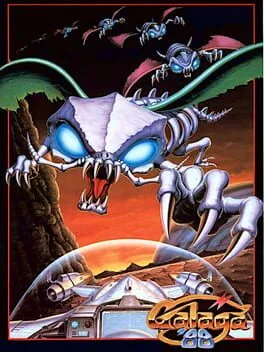
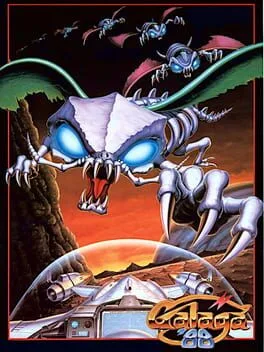
Galaga '88
TurboGrafx-16 · 1987
About this game
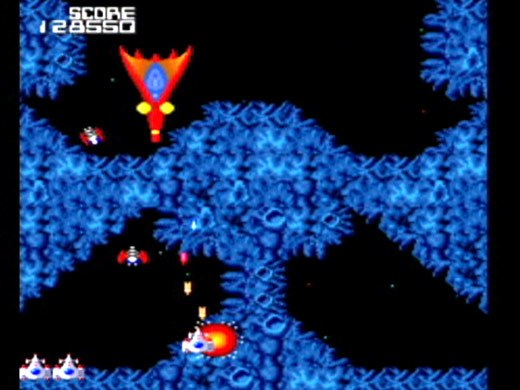
The gameplay in Galaga '88 is built on the same premise as that of the original Galaga game, but is in many ways more complex and more difficult.
The game is divided into a series of 29 Stages distributed through eight Worlds.
↓ Read more
The starship Galaga accelerates between Stages and Worlds and even to higher dimensions (go to the section on Dimensional Travel below to find out more).
With the exception of the third and eighth, each World culminates in a Challenging Stage.
There are six such stages to engage in any full game, and each begins with the on-screen announcement "That's Galactic Dancin'!" and has its own YM2151-generated song to which the enemy formations dance.
In any given Challenging Stage, both the design of the enemies and their dancing formations shall vary according to the player's current Dimension.
As in Galaga, the objective is to destroy all forty enemies before they fly away off the screen.
However, refraining completely from touching any controls for the duration of a Challenging Stage awards a "secret bonus" ranging in value from 10000 to 25000 points, and equal to the "special bonus" which would have been awarded for destroying all forty enemy aliens instead.
Galaga '88 introduces a variety of new enemies and behaviors.
Most of these special enemies are worth varying amounts of bonus points when destroyed.
Some enemies can combine into larger enemies which take multiple hits to destroy, while others arrive in eggs, explode in a shower of fireworks, grow with multiple hits, or sport armor which makes them invincible while in formation.
Certain enemies drop small formations of tiny creatures that wiggle their way down the screen, and still others can act as escorts to incoming groups of enemies and then quickly dive at the player before leaving the game.
Most stages also include various obstacles which appear once the enemy formation has been assembled.
These can be destroyed with either one or several shots, and the first one on each stage will leave a "Warp Capsule".
At the start of the game, the player can select how many Galaga starships to start with (one or two), affecting their number of remaining lives.
The game ends after the final boss is defeated (or when the player's last ship is destroyed or captured) - in the latter case, the player can continue the game for an additional credit.
The Game Over screen shows the player's hit-miss ratio and a visual representation of their progress.
If the player reaches Stage 27, the game also shows a picture of the final boss (damaged if defeated, but silhouetted if not).
If the arcade operator has set the "continue" option to "on", the player also cannot continue if he is defeated on Stages 27-29.
About TurboGrafx-16
Known as the PC Engine in Japan, the TurboGrafx-16 (1989) punched well above its small form factor but never found a large audience in North America, leading to one of the smallest console libraries of its generation in the West. That limited Western release makes complete, boxed TurboGrafx-16 games some of the scarcer finds in retro console collecting today.
Gamevaro tracks Galaga '88 for TurboGrafx-16 with separate market values for loose, complete-in-box (CIB) and factory-sealed copies, sourced from real eBay sales. Prices also vary by region — PAL, NTSC-U and NTSC-J releases of the same game often sell for different amounts due to print run sizes and regional collector demand.
Adding Galaga '88 to a Gamevaro collection takes seconds — search by title or scan the box barcode, and the app fills in cover art, release details and current pricing automatically. This TG16 release dates back to 1987.
Market values by condition
NTSC-U
Recent sales
| Date | Type | Region | Price |
|---|---|---|---|
| 2026-07-19 | Loose / Item only | NTSC-U | €30.99 |
Rarity & condition
Only a handful of market sales have been tracked for Galaga '88, suggesting it doesn't trade hands very often — a sign of relative scarcity compared to more common TurboGrafx-16 titles.
Complete-in-box (CIB) copies typically command a premium over loose cartridges/discs because the original box and manual are more fragile and get discarded or damaged over time — fewer complete sets survive.
Frequently asked questions
How much is Galaga '88 worth?
Galaga '88 for TurboGrafx-16 is currently worth €30.99 loose. Prices are based on real sales and update regularly on Gamevaro.
Is Galaga '88 rare?
Galaga '88 has only a handful of tracked market sales, suggesting relative scarcity compared to more common TurboGrafx-16 titles.
What's the difference between loose, CIB and sealed for Galaga '88?
Loose means cartridge or disc only, CIB (complete in box) includes the original box and manual, and sealed means factory-sealed and never opened. These are tracked as separate market values because the price gap between them can be significant, especially for older releases.
Ratings & Reviews
Also on other platforms


More TurboGrafx-16 games